Enhanced Skin Cancer Detection Utilizing Enhanced Densenet121
Abstract
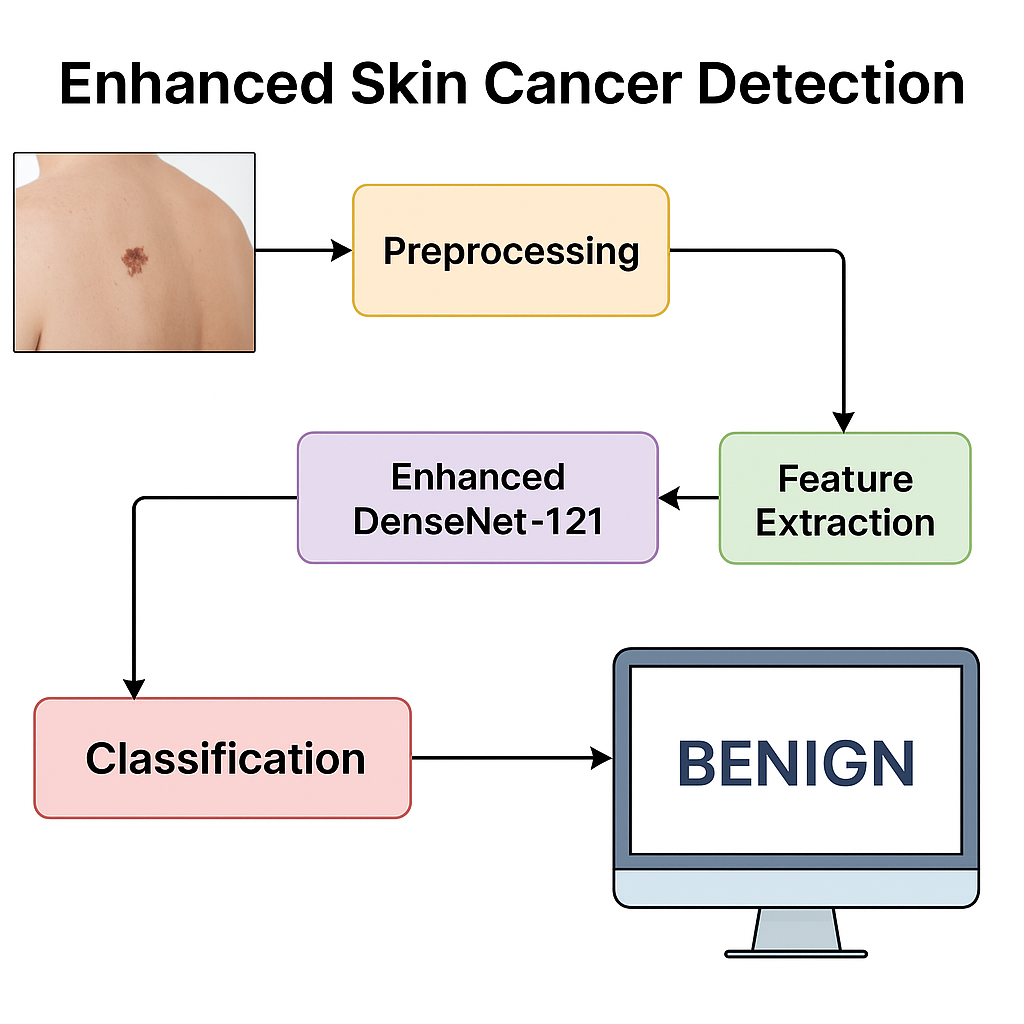
Skin cancer remains one of the most common and potentially fatal forms of cancer worldwide, with early detection being critical to effective treatment. Traditional diagnostic methods often suffer from subjectivity and limited accessibility, highlighting the need for automated, accurate, and scalable diagnostic systems. This study aims to develop an enhanced deep learning model based on DenseNet121 to improve the accuracy and robustness of automated skin cancer detection using dermoscopic images. The proposed approach integrates a Convolutional Block Attention Module (CBAM) into the DenseNet121 architecture, enabling the model to focus on clinically significant lesion regions. The model was trained on the publicly available ISIC 2018 dataset, which includes 10,015 images across seven skin lesion classes. Preprocessing steps included image resizing, histogram equalization, and data augmentation, while a class-weighted categorical cross-entropy loss function was used to address dataset imbalance. Model evaluation was conducted using five-fold cross-validation and multiple performance metrics. The Enhanced DenseNet121 model achieved an accuracy of 91.1%, F1-score of 89.0%, and AUC-ROC of 94.2%, outperforming ResNet50, InceptionV3, EfficientNet-B0, and the baseline DenseNet121. Statistical significance testing yielded a p-value of 0.0084, confirming the robustness of the improvements. The proposed model demonstrates superior diagnostic performance, efficient parameter utilization, and improved focus on relevant lesion areas. Its deployment potential in mobile health platforms and clinical decision support systems suggests a valuable contribution toward accessible, AI-driven skin cancer screening in real-world settings
Downloads
Published
Issue
Section
License

This work is licensed under a Creative Commons Attribution-NonCommercial 4.0 International License.
This work is licensed under a Creative Commons Attribution-NonCommercial 4.0 International License. You are free to share and adapt the material, but only for non-commercial purposes. You must give appropriate credit to the author(s).