Digital-Twin Driven AI Framework for Climate-Adaptive Crop Yield Forecasting Using Multi-Source Satellite and Weather Data
Keywords:
Digital Twin, Crop Yield Forecasting, Spatiotemporal Deep Learning, Remote Sensing, Climate Adaptation, Graph Neural Networks, Meta-Learning, Precision Agriculture.Abstract
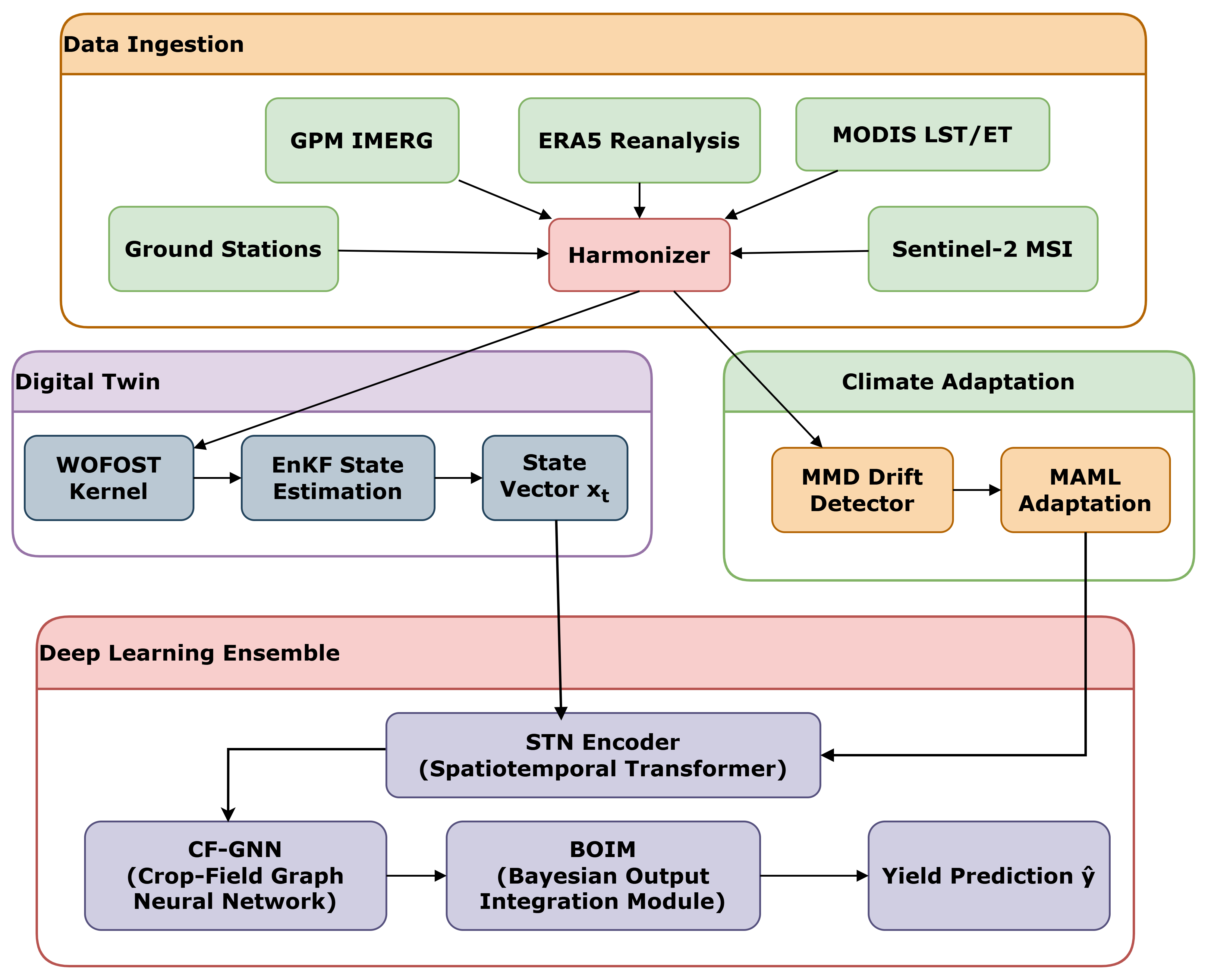
Accurate crop yield forecasting under climate variability remains a critical challenge for global food security, as extreme weather events intensify and conventional tools fail to capture agro-ecosystem complexity. Existing approaches including process-based crop models, statistical regression frameworks, and remote sensing-driven empirical methods suffer from limited adaptability, poor spatial transferability, and inability to assimilate real-time data under non-stationary climate conditions. This paper presents a Digital-Twin Driven Artificial Intelligence (DTAI) framework integrating multi-source satellite data from Sentinel-2, MODIS, ERA5 reanalysis, and GPM precipitation within a physics-informed crop growth simulation environment. A field-scale digital twin is constructed using an Ensemble Kalman Filter for continuous state estimation, feeding a hierarchical deep learning ensemble comprising a Spatiotemporal Transformer Network, a Crop-Field Graph Neural Network, and a Bayesian Output Integration Module. Climate adaptability is achieved through a Model-Agnostic Meta-Learning mechanism that detects distributional shift via Maximum Mean Discrepancy and recalibrates model parameters using minimal in-season observations. Experimental evaluation across four agro-climatic zones covering seven crop-region combinations over five growing seasons produced a Mean Absolute Percentage Error of 4.3%, Root Mean Squared Error of 0.31 t/ha, and R-squared of 0.94, outperforming four established baselines by 18 to 43 percent. The DTAI framework achieves full recalibration within 12 days during anomalous seasons and near-supervised accuracy through twenty-shot domain adaptation, establishing a scalable and climate-resilient decision-support tool for food security monitoring
Downloads
Published
Issue
Section
License

This work is licensed under a Creative Commons Attribution-NonCommercial 4.0 International License.
This work is licensed under a Creative Commons Attribution-NonCommercial 4.0 International License. You are free to share and adapt the material, but only for non-commercial purposes. You must give appropriate credit to the author(s).