Real-Time Cognitive Load Estimation in Augmented Reality Interfaces Using EEG-Driven Adaptive Algorithms
Keywords:
Cognitive Load Estimation, EEG, Augmented Reality, CNN–LSTM, Adaptive Interface, Brain–Computer Interface, Real-Time Classification, Usability Evaluation.Abstract
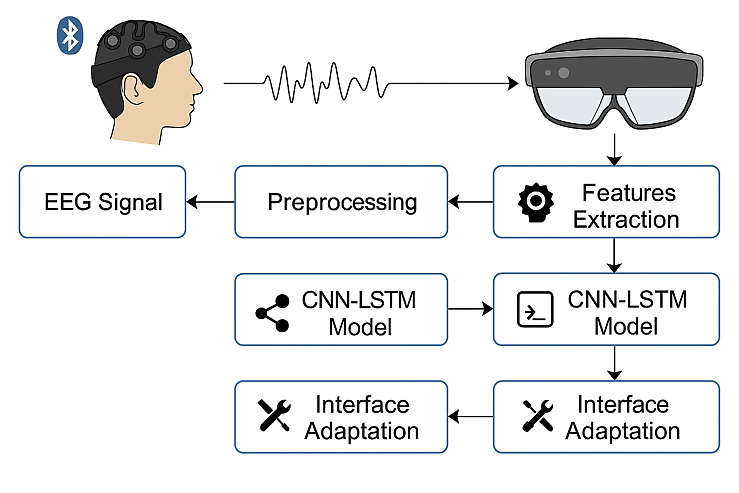
Augmented reality (AR) systems increasingly support complex decision-making and user interaction, but high visual density often results in cognitive overload, reducing performance and increasing fatigue. Traditional methods for estimating cognitive load are either retrospective or too invasive for seamless real-time adaptation. This study aims to develop a real-time, EEG-driven cognitive load estimation model integrated with an adaptive AR interface to dynamically adjust content based on user mental effort. A hybrid CNN–LSTM deep learning architecture was trained on the STEW EEG dataset using band-specific power spectral density and Hjorth features extracted from preprocessed signals. The model was evaluated using subject-wise 5-fold cross-validation and deployed in an AR environment using TensorFlow Lite on Microsoft HoloLens 2. Real-time inference was achieved with a latency of 24.5 ms and a deployable model size of 9.2 MB. The proposed model achieved 90% classification accuracy and a macro-averaged F1-score of 89%, outperforming SVM, Random Forest, and CNN baselines. Usability tests in AR showed a 31.7% reduction in NASA-TLX scores, a 25.4% decrease in task error rates, and a 14.8-second improvement in task completion time using multi-class adaptive UI. This research demonstrates that real-time EEG-based cognitive estimation can significantly enhance user experience in AR systems. The proposed framework offers a scalable and efficient solution for neuroadaptive interfaces in training, healthcare, and industrial applications
Downloads
Published
Issue
Section
License

This work is licensed under a Creative Commons Attribution-NonCommercial 4.0 International License.
This work is licensed under a Creative Commons Attribution-NonCommercial 4.0 International License. You are free to share and adapt the material, but only for non-commercial purposes. You must give appropriate credit to the author(s).