Meta-Learning Algorithms for Accelerated Drug Target Identification from Multi-Omics Datasets
Keywords:
Meta-learning, Multi-omics Integration, Drug Target Identification, Few-shot Learning, Precision Medicine, TCGA, MAML, Biomedical AIAbstract
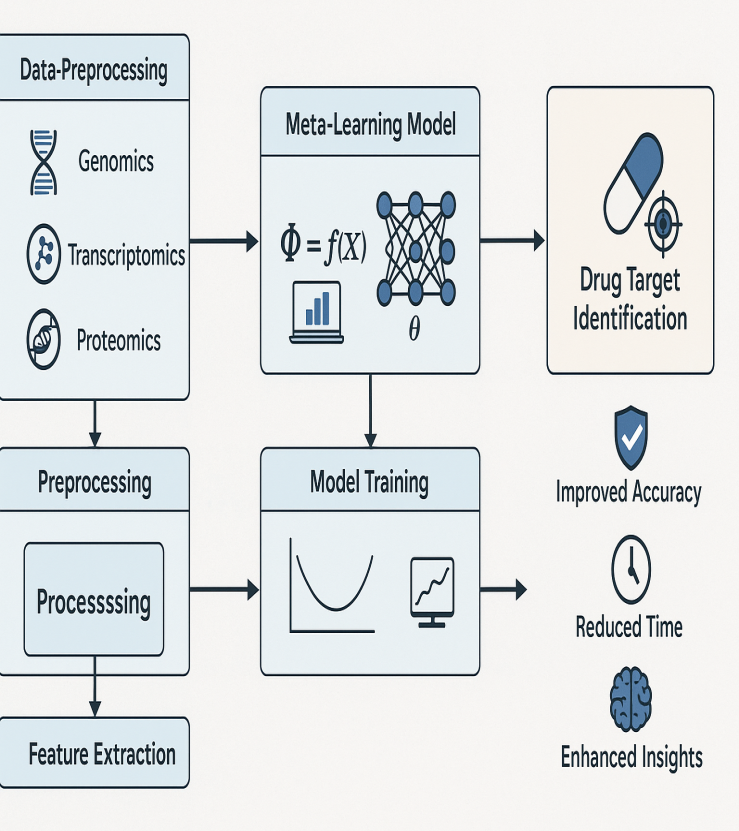
Drug target identification remains a fundamental bottleneck in modern drug discovery, particularly when dealing with high-dimensional and heterogeneous multi-omics data. Traditional machine learning models are often limited by data scarcity and poor generalization across biological contexts. This study proposes a meta-learning framework to accelerate drug target identification by efficiently leveraging multi-omics datasets under few-shot learning conditions. We utilized the TCGA multi-omics dataset encompassing genomics, transcriptomics, proteomics, and DNA methylation layers. A Model-Agnostic Meta-Learning (MAML) strategy was implemented, enabling the model to generalize across diverse biological tasks using a 5-way 1-shot learning protocol. Dimensionality reduction was achieved using principal component analysis and autoencoders, and each task was constructed by pairing support and query samples across cancer types and age groups. The model was trained and evaluated on 2500 tasks with optimized inner and outer learning rates (α = 0.01, β = 0.001). The proposed framework achieved an average accuracy of 89.3%, F1-score of 88.7%, and AUC of 0.91, outperforming baseline models including CNNs (82.4% accuracy) and Transformers (84.1% accuracy). Drug response analysis revealed peak model performance in the 51–70 age group, with Drug D achieving 88.9% prediction accuracy in this demographic. The meta-learner maintained high adaptability across drug types, age brackets, and omics layers. This work demonstrates the effectiveness of meta-learning for rapid and reliable drug target identification in low-data regimes. It offers a scalable, accurate, and clinically relevant approach for advancing precision medicine and age-aware therapeutic planning.
Downloads
Published
Issue
Section
License

This work is licensed under a Creative Commons Attribution-NonCommercial 4.0 International License.
This work is licensed under a Creative Commons Attribution-NonCommercial 4.0 International License. You are free to share and adapt the material, but only for non-commercial purposes. You must give appropriate credit to the author(s).