Decentralized Lightweight Group Key Agreement for IoT Using ECC, Shamir’s Sharing, and ChaCha20
Keywords:
Group Key Agreement, IoT Security, ECC, Shamir’s Secret Sharing, ChaCha20, Lightweight Cryptography, Decentralized Protocol, ESP32, BoT-IoT Dataset, Secure Communication.Abstract
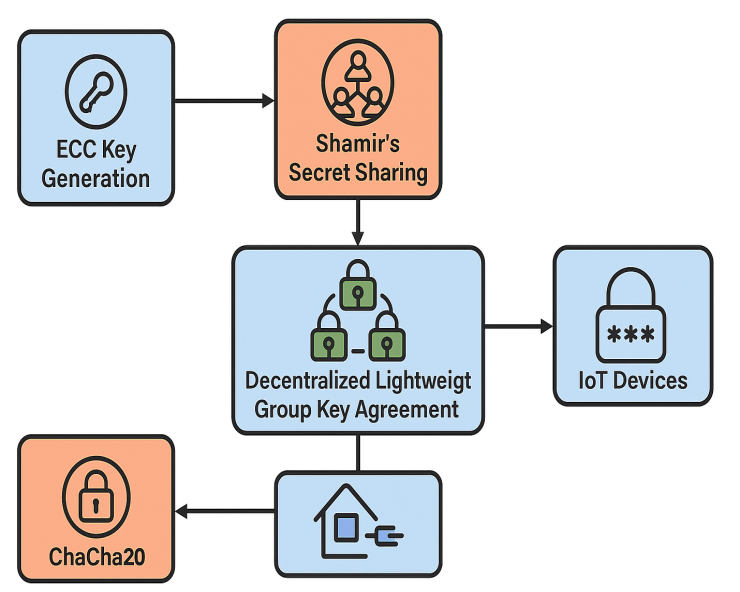
The exponential growth of Internet of Things (IoT) devices has amplified the need for secure, scalable, and lightweight group communication protocols. Traditional centralized key distribution schemes and heavyweight cryptographic operations, such as RSA or standard AES, are impractical for resource-constrained IoT nodes due to their high computation and energy demands. This study proposes a decentralized, lightweight group key agreement (DL-GKA) framework that ensures secure group communication while minimizing latency and energy overhead in IoT environments. The proposed DL-GKA protocol integrates Elliptic Curve Cryptography (ECC) for key pair generation, Shamir’s Secret Sharing for threshold-based key distribution, and ChaCha20 for high-speed, constant-time encryption. The framework is tested using the BoT-IoT-L01 intrusion detection dataset to simulate real-world traffic conditions, and implemented across a 50-node ESP32-C3 test-bed running Contiki-NG. Performance metrics are recorded under multiple configurations and thresholds to evaluate scalability and resilience. DL-GKA reduces end-to-end latency by up to 77% and energy consumption per packet by 50% compared to centralized ECC-AES baselines. Communication overhead remains below 8.3% even in 50-node groups, and the protocol achieves a security margin of 5 at threshold . Packet delivery times remain within 15 ms for over 90% of cases, even under DoS traffic. DL-GKA offers a robust, scalable, and energy-efficient alternative to traditional key management protocols in IoT. Its decentralized architecture, tunable security settings, and lightweight cryptographic stack make it highly suitable for practical deployments in smart cities, healthcare, and industrial automation.
Downloads
Published
Issue
Section
License

This work is licensed under a Creative Commons Attribution-NonCommercial 4.0 International License.
This work is licensed under a Creative Commons Attribution-NonCommercial 4.0 International License. You are free to share and adapt the material, but only for non-commercial purposes. You must give appropriate credit to the author(s).