Hybrid Quantum-Classical Learning for Accelerating Cryptographic Key Distribution in Post-Quantum Networks
Keywords:
Hybrid Learning, Post-Quantum Cryptography, Quantum Key Distribution, Variational Quantum Circuits, Quantum Noise Resilience, Cryptographic Key Management, Secure CommunicationAbstract
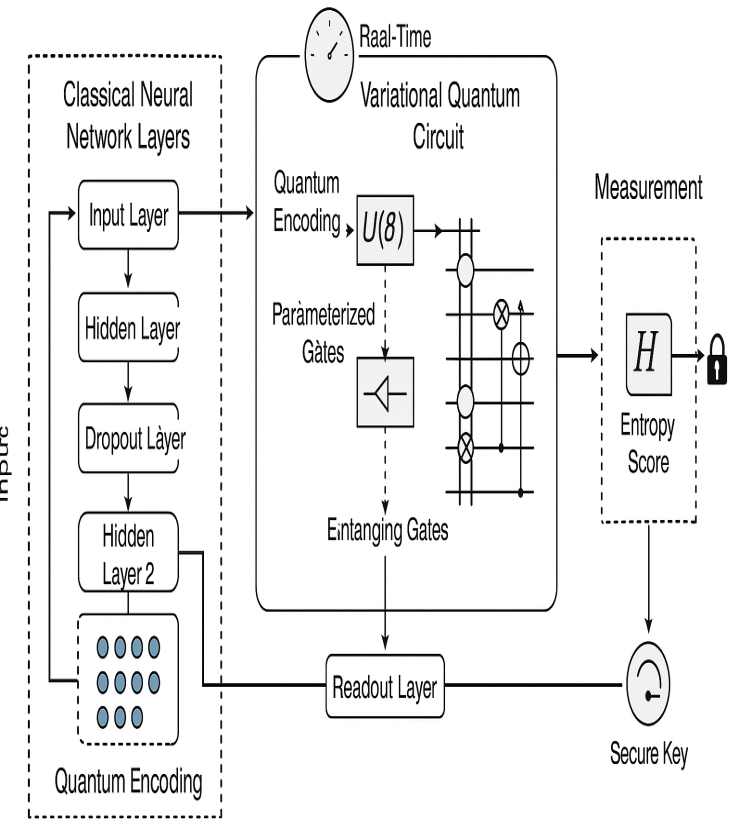
The rise of quantum computing poses a significant threat to traditional cryptographic protocols, especially public-key systems reliant on factorization and discrete logarithms. Existing post-quantum and quantum key distribution (QKD) schemes face challenges in real-time adaptability, noise resilience, and deployment feasibility. This study proposes a hybrid quantum-classical learning framework to enhance the efficiency and robustness of cryptographic key distribution in post-quantum networks. The model integrates classical deep neural networks with variational quantum circuits (VQC) to process quantum gate operations and generate high-entropy cryptographic keys. A real-world quantum computing simulation dataset from Kaggle is used to train and validate the model. Key features are encoded using angle and amplitude encoding techniques, while entropy-driven feedback is used to iteratively optimize key quality. The framework was developed using PyTorch, Pennylane, and Qiskit, with implementation tested under variable quantum noise environments using 5-fold cross-validation. The hybrid model achieved an accuracy of 96.8%, an F1-score of 95.8%, and the lowest observed Quantum Bit Error Rate (QBER) of 4.5%, outperforming traditional deep neural networks and QSVC by over 3%. The entropy score exceeded 0.95, even in high-noise conditions. Inference latency was recorded at 10 ms, supporting real-time deployment. The proposed model demonstrates strong potential for scalable, adaptive, and secure post-quantum key management. It is well-suited for integration in quantum communication, 6G IoT, and block chain systems, contributing toward future-ready cryptographic infrastructures.
Downloads
Published
Issue
Section
License

This work is licensed under a Creative Commons Attribution-NonCommercial 4.0 International License.
This work is licensed under a Creative Commons Attribution-NonCommercial 4.0 International License. You are free to share and adapt the material, but only for non-commercial purposes. You must give appropriate credit to the author(s).