Transfer Learning for Agile Pedestrian Dynamics Analysis Enabling Real-Time Safety at Zebra Crossings
Keywords:
Pedestrian safety, transfer learning, CNN-LSTM, zebra crossings, smart transportation, real-time inference, edge computing, PIE datasetAbstract
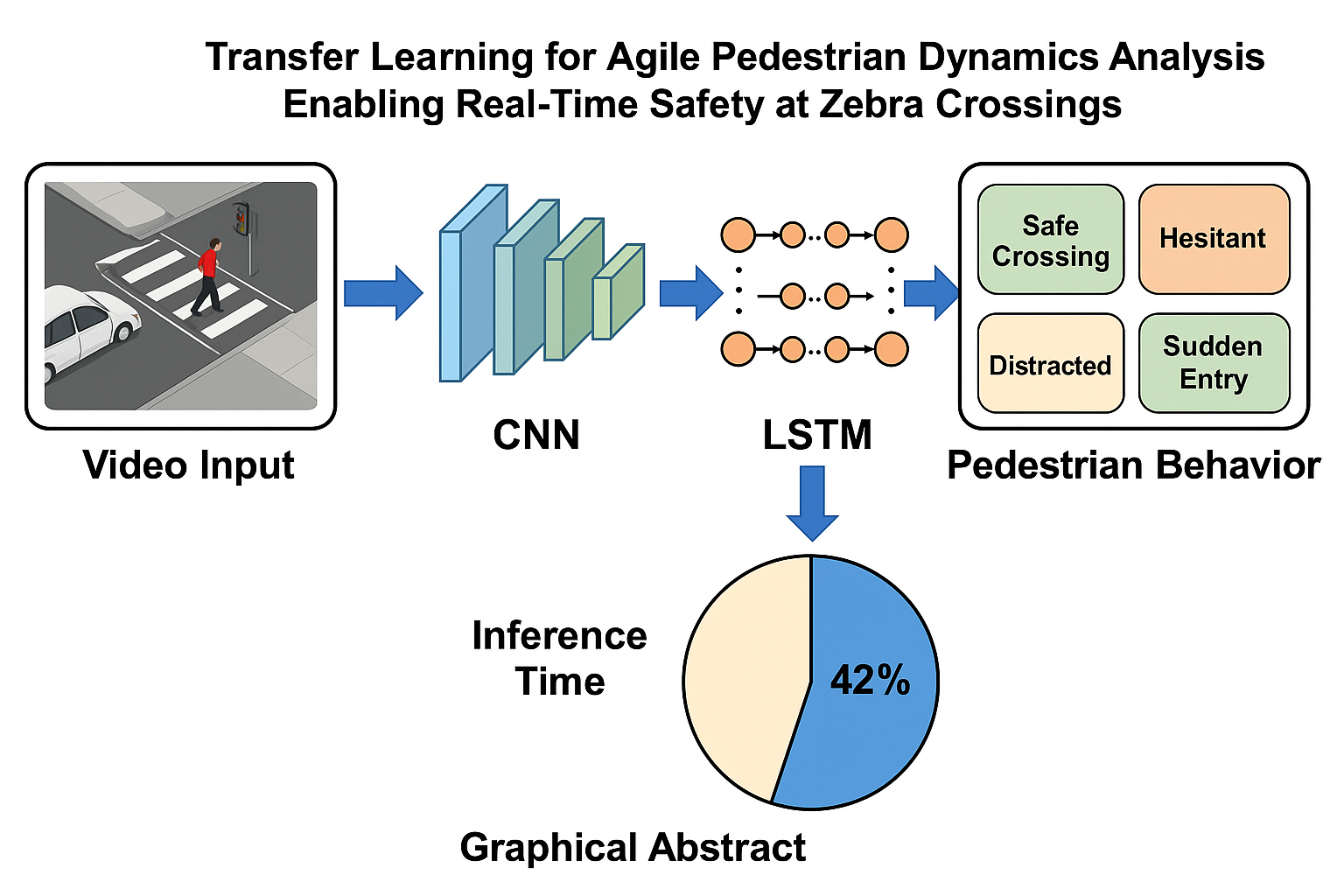
Ensuring pedestrian safety at zebra crossings is a critical challenge in smart urban mobility, where unpredictable human behaviours and limited sensing capabilities often lead to accidents. Traditional surveillance systems lack the intelligence to interpret pedestrian intent in real time, especially in rapidly changing environments. This study aims to develop an efficient, deployable framework for real-time pedestrian behaviour classification using transfer learning techniques and temporal modelling. The proposed model integrates a convolutional neural network (CNN) with a Long Short-Term Memory (LSTM) network to extract spatial-temporal features from video sequences. Pre-trained CNNs (ResNet50 and MobileNetV2) are fine-tuned on the PIE (Pedestrian Intention Estimation) dataset, which provides over 6 hours of annotated pedestrian videos. Data augmentation and histogram normalization are applied during pre-processing, and the model is optimized using the Adam optimizer with early stopping and learning rate scheduling. Real-time deployment feasibility is tested on edge hardware (NVIDIA Jetson Nano) using TensorRT. Experimental results show that the proposed CNN-LSTM model achieves an accuracy of 92.7% and an F1-score of 0.89, outperforming baseline CNN (85.2%) and Transformer-based (91.1%) models. The system maintains inference speed of 28 FPS on Jetson Nano, with behaviour-wise F1-scores of 0.92 (safe crossing), 0.87 (hesitant), 0.85 (distracted), and 0.89 (sudden entry). A pie-chart analysis reveals that CNN computation accounts for 42% of inference time, indicating efficient design. The framework demonstrates strong potential for deployment in smart poles and connected traffic infrastructure, enabling timely pedestrian risk alerts and enhancing safety in real-world urban environments.
Downloads
Published
Issue
Section
License

This work is licensed under a Creative Commons Attribution-NonCommercial 4.0 International License.
This work is licensed under a Creative Commons Attribution-NonCommercial 4.0 International License. You are free to share and adapt the material, but only for non-commercial purposes. You must give appropriate credit to the author(s).