Graph Neural Networks for Dynamic Protein-Protein Interaction Prediction in Disease-Specific Pathway Modeling
Keywords:
Dynamic Graph Neural Networks, Protein-Protein Interactions, Temporal Consistency, Bioinformatics, Biomedical AI, Disease Pathway Modelling, Explainable AI, Multi-Omics IntegrationAbstract
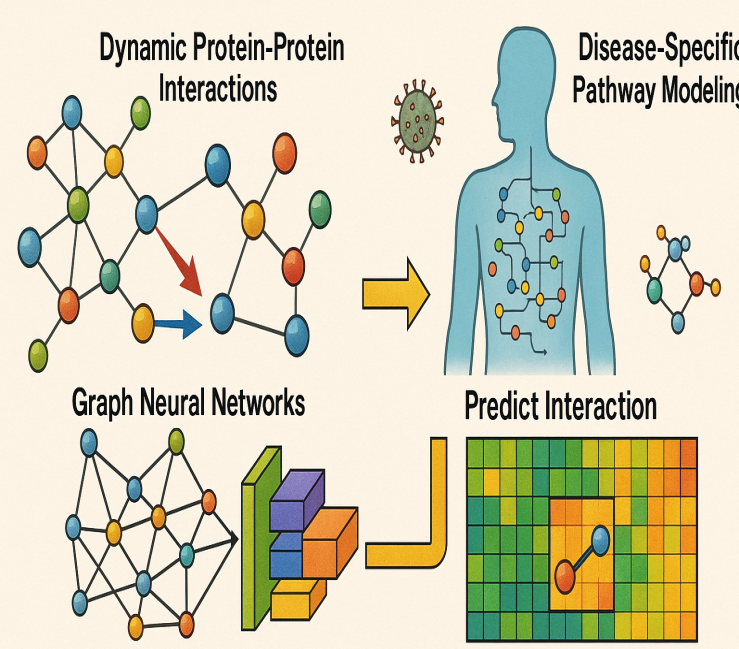
Protein-protein interactions (PPIs) are fundamental to understanding cellular function and disease mechanisms. Traditional computational models often rely on static representations of interaction networks, which overlook the dynamic and condition-specific nature of biological systems. This study aims to develop a dynamic graph neural network (GNN) framework capable of predicting disease-specific PPIs by modelling their temporal evolution across varying biological conditions. We construct time-ordered protein interaction graphs using the BioGRID dataset, integrating gene expression, structural, and phenotypic features. A dynamic GNN with gated recurrent units processes these graphs across multiple time windows, capturing evolving topologies. The model is trained using binary cross-entropy and evaluated using accuracy, F1-score, AUC, and Temporal Consistency Score (TCS). Comparative analysis is performed against baselines such as static GCNs, matrix factorization, and self-supervised models. Our model achieves an average accuracy of 94%, F1-score of 91%, and AUC of 0.94 across diverse diseases and phenotypic groups. Notably, the TCS reaches up to 0.91 in progressive diseases like Parkinson’s, indicating high temporal prediction stability. ROC and heat map analyses confirm superior performance over existing methods, with p-values < 0.01 validating statistical significance. The proposed model effectively captures dynamic, disease-specific PPI changes, outperforming current methods in both predictive performance and temporal robustness. It holds substantial promise for applications in clinical decision support, biomarker discovery, and cross-species biological research
Downloads
Published
Issue
Section
License

This work is licensed under a Creative Commons Attribution-NonCommercial 4.0 International License.
This work is licensed under a Creative Commons Attribution-NonCommercial 4.0 International License. You are free to share and adapt the material, but only for non-commercial purposes. You must give appropriate credit to the author(s).