Deep Reinforcement Learning Framework for Optimizing Multi-Gene CRISPR-Cas9 Editing Strategies in Crop Genomics
Keywords:
Deep Reinforcement Learning (DRL), CRISPR-Cas9, Multi-Gene Editing, Crop Genomics, PPO Algorithm, Genome Optimization, Bioinformatics, Precision Agriculture, Off-Target Minimization, Gene SelectionAbstract
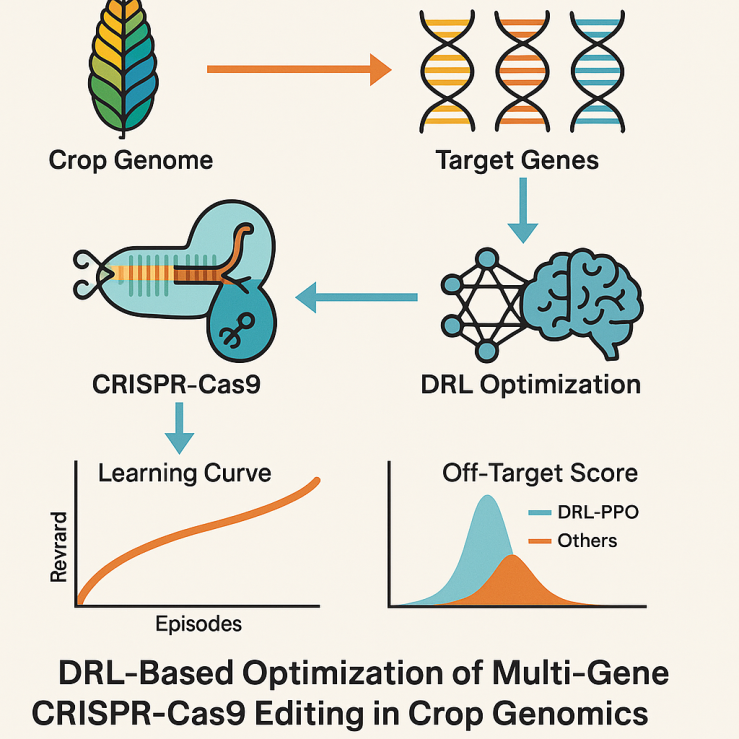
The advancement of CRISPR-Cas9 has significantly enhanced genome editing in agriculture; however, most existing tools focus on single-gene editing and lack adaptability for complex multi-gene interventions. This limitation is critical because traits such as drought tolerance, disease resistance, and yield optimization in crops are often governed by interconnected gene networks. Traditional heuristic or rule-based approaches are not sufficient to handle the dynamic, sequential nature of multi-locus genome editing.This study proposes a deep reinforcement learning (DRL) framework, based on the Proximal Policy Optimization (PPO) algorithm, to intelligently optimize gene target selection across multiple loci in crop genomes. Using real genomic data from CRISPR-P 2.0 for Oryza sativa (rice), the editing task is modelled as a Markov Decision Process (MDP), where states represent genome features and actions correspond to candidate gene edits. A biologically-informed reward function is used to guide the learning agent toward high-efficiency, low off-target edits. The proposed DRL model achieved an editing accuracy of 91.2%, an F1-score of 0.89, and an average off-target score of 0.12, significantly outperforming rule-based (74.6%) and CNN-based (80.3%) methods. It demonstrated consistent convergence, balanced decision-making, and superior performance in precision and generalization. In conclusion, the integration of DRL with genome editing presents a scalable and intelligent alternative to static gene-editing pipelines. This work contributes to the automation of multi-trait crop engineering and lays the foundation for biologically aware, data-driven genome editing systems
Downloads
Published
Issue
Section
License

This work is licensed under a Creative Commons Attribution-NonCommercial 4.0 International License.
This work is licensed under a Creative Commons Attribution-NonCommercial 4.0 International License. You are free to share and adapt the material, but only for non-commercial purposes. You must give appropriate credit to the author(s).