Agentic AI Framework for Multi-Step Decision Making in Complex Dynamic Environments
Keywords:
Agentic Artificial Intelligence, Multi-Step Decision Making, Reinforcement Learning, Hierarchical Planning, Memory-Augmented Reasoning, Uncertainty-Aware Learning, Dynamic EnvironmentsAbstract
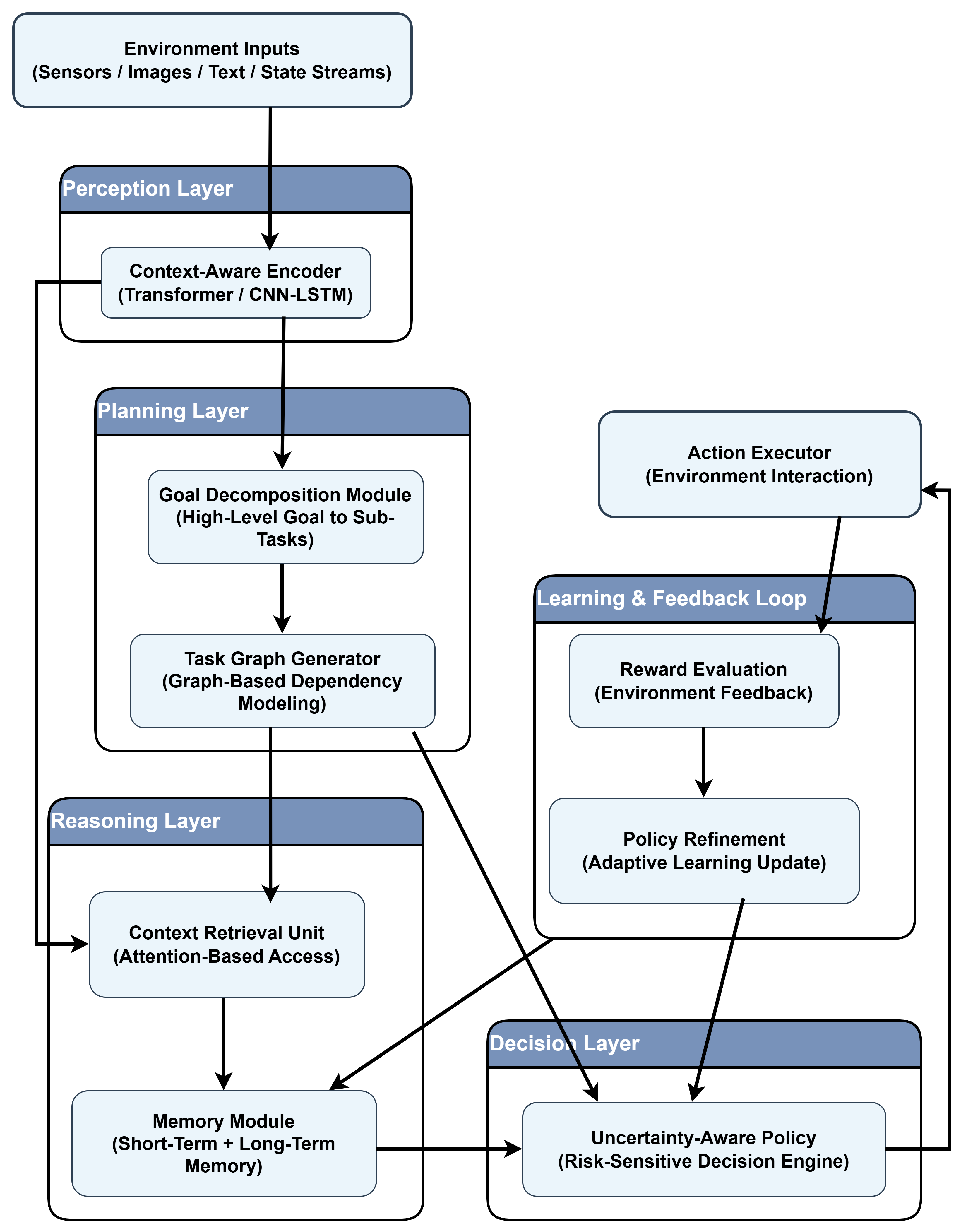
The ability of autonomous decision-making in complex dynamic settings has evolved as a pressing issue in the contemporary application of artificial intelligence, and such as robotics, cyber-physical systems and intelligent control. These settings have partial observability, long-horizon dependencies and are uncertain and limit the applicability of classic reinforcement learning and sequence-based decision models. Current solutions are not always structured, lack memory integration and free-flowing adaptive reasoning, resulting in sub-optimal performance of multi-step tasks. To overcome these drawbacks, this paper suggests an Agentic Multi-Step Decision Intelligence (AMSDI) system that leverages a perceptual system that takes into consideration the context, a goal decomposition system with task graphs, memory-enhanced reasoning, and uncertainty-based policy learning, all within a single architecture. The framework allows autonomous agents to make plans, reason and change action iteratively with long decision horizons. The proposed model is tested in a variety of benchmark settings, such as MiniGrid, ALFWorld, and Meta-World, and compared to practically relevant baseline models, including PPO, Options Framework, Decision Transformer, ReAct Agent, and Neural Episodic Control. The experimental findings indicate that AMSDI has a Task Success Rate of 0.89, which is better than baselines by up to 7-18 and more efficient in multi-step processing and reduced uncertainty in decisions by approximately 20%. Such results suggest that the developed framework delivers a scalable and versatile model of autonomous multi-step decision-making, and has a high chance of implementation in dynamic and uncertain settings in real-life.
Downloads
Published
Issue
Section
License

This work is licensed under a Creative Commons Attribution-NonCommercial 4.0 International License.
This work is licensed under a Creative Commons Attribution-NonCommercial 4.0 International License. You are free to share and adapt the material, but only for non-commercial purposes. You must give appropriate credit to the author(s).