AI-Designed Microenvironment Scaffolds for Predictable Organoid Morphogenesis and Functional Reliability
Keywords:
Organoids, Artificial Intelligence, Scaffold Design, Reinforcement Learning, Multimodal Data Fusion, Regenerative MedicineAbstract
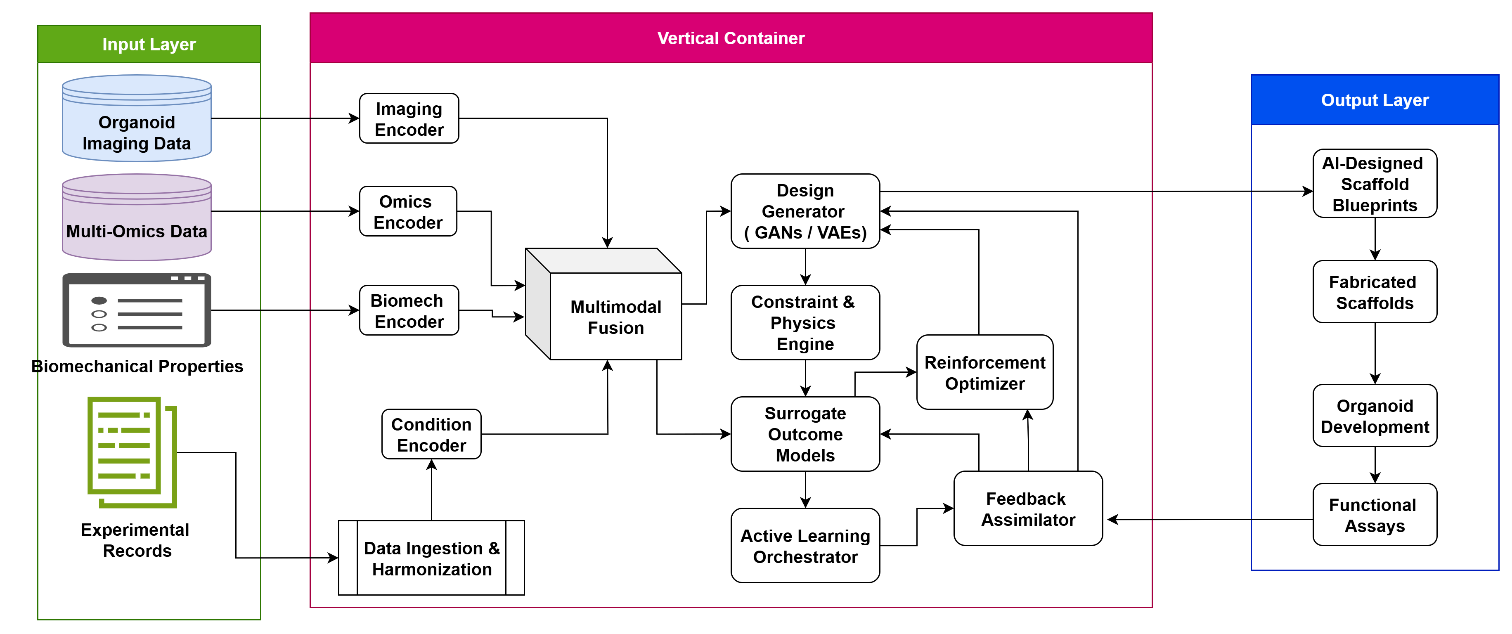
Organoids have emerged as robust three-dimensional systems for analyzing human development, disease, and treatment therapies. However, morphogenesis and functional outcomes vary significantly, and this high variability hinders their widespread application, particularly due to a lack of control over microenvironmental scaffolds. Traditional scaffold design methods, whether empirical, physics-based, or involving limited AI application struggle to provide predictive and reproducible guidance. Research indicates that AI-based scaffold design can enhance the predictability of organoid morphogenesis and functional reproducibility. The model integrates various modalities, including transcription, imaging, and biomechanical datasets. Generative adversarial networks were utilized to propose new scaffold designs, while physics-informed constraints ensured biological feasibility. Surrogate models were trained to predict scaffold-organoid interactions, and reinforcement learning was employed to iteratively improve scaffold configurations based on surrogate predictions. Comparative analysis was conducted against empirical, unimodal, generative-only, and physics-only baselines. The proposed framework reduced morphological variation by more than half compared to empirical baselines, achieving a structural similarity index (SSIM) of 0.89 and a structural functional reproducibility represented by an intra-class correlation coefficient (ICC) of 0.81. Surrogate models demonstrated a 50% reduction in mean squared error compared to unimodal models, while reinforcement learning resulted in a 35-fold increase in cumulative reward, indicating greater optimization efficiency. This research integrates multimodal fusion, generative modeling, and reinforcement learning with physics-informed constraints, establishing it as a pioneering study in predictive and adaptive scaffold design. The results advance organoid engineering, making it more reproducible, scalable, and clinically applicable.
Downloads
Published
Issue
Section
License
Copyright (c) 2025 Tom Yeh, Paul S Pang, S JanReddy, M. Harshini (Author)

This work is licensed under a Creative Commons Attribution-NonCommercial 4.0 International License.
This work is licensed under a Creative Commons Attribution-NonCommercial 4.0 International License. You are free to share and adapt the material, but only for non-commercial purposes. You must give appropriate credit to the author(s).