Self-Adaptive AI Framework for Fault-Tolerant Data Transmission in Satellite-to-Ground Communication Systems
Keywords:
Satellite communication, fault tolerance, reinforcement learning, deep learning, LSTM, CNN, PPO, adaptive systems, anomaly detection, link stabilityAbstract
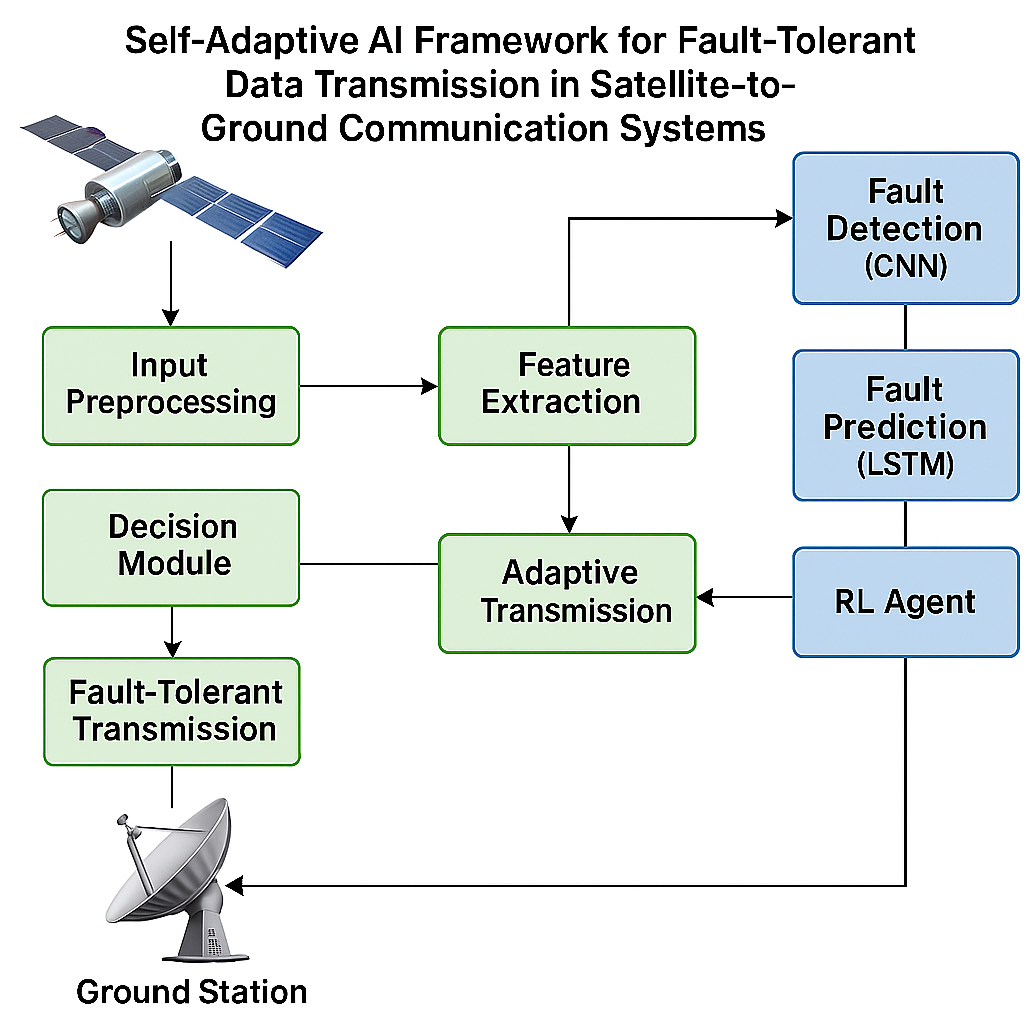
Satellite-to-ground communication systems are highly susceptible to disruptions caused by link degradation, hardware faults, and atmospheric conditions, often leading to reduced reliability and data loss in mission-critical operations. Traditional fault-handling methods are static and lack adaptability, limiting their effectiveness in dynamic space environments. This study aims to design a unified, intelligent framework for fault-tolerant data transmission that integrates detection, prediction, and adaptive control using advanced AI techniques. The proposed Self-Adaptive AI Framework (ASG-NCF) employs Convolutional Neural Networks (CNNs) for real-time fault detection, Long Short-Term Memory (LSTM) networks for sequential fault prediction, and a Proximal Policy Optimization (PPO)-based Reinforcement Learning (RL) agent for adaptive transmission control. The model is trained and validated using satellite link traces generated from the SatComSim-X simulator, incorporating synthetic fault injections and real-world link dynamics. Evaluation metrics include bit error rate (BER), packet delivery ratio (PDR), latency, and stable uplink ratio (SUR). ASG-NCF achieved a fault detection accuracy of 94.6%, fault prediction top-2 accuracy of 91.6%, and a stable uplink ratio of 92.8%. The system reduced recovery latency to 11 time steps and significantly outperformed rule-based and Q-learning control strategies in both cumulative reward and recovery efficiency. Statistical significance testing confirmed the robustness of improvements (p < 0.01 across all metrics). By unifying AI-driven modules into an adaptive control loop, ASG-NCF enhances communication resilience in dynamic satellite environments. The framework is scalable, robust, and suitable for deployment in next-generation autonomous satellite networks and ground station infrastructures
Downloads
Published
Issue
Section
License

This work is licensed under a Creative Commons Attribution-NonCommercial 4.0 International License.
This work is licensed under a Creative Commons Attribution-NonCommercial 4.0 International License. You are free to share and adapt the material, but only for non-commercial purposes. You must give appropriate credit to the author(s).