Hybrid Deep Learning Framework for Real-Time Wildfire Spread Forecasting from Multimodal Satellite Streams
Keywords:
Wildfire Forecasting, Multimodal Deep Learning, Satellite Remote Sensing, Spatiotemporal Modeling, Transformer Networks, Real-Time Prediction, Environmental Data FusionAbstract
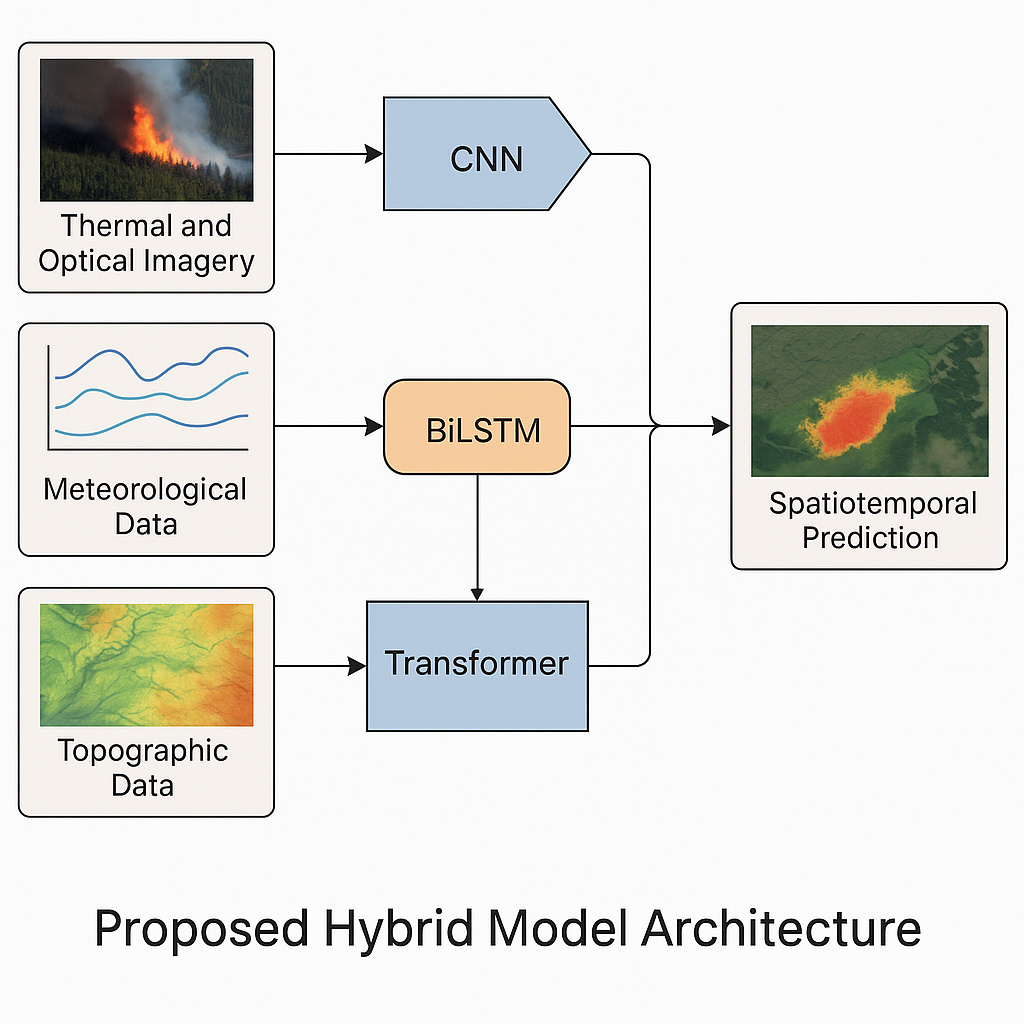
Wildfires pose escalating threats to ecological systems, infrastructure, and human life, intensified by climate change and extreme weather events. Existing fire spread models, both rule-based and data-driven, often lack real-time capability and fail to generalize across diverse geographic regions due to their reliance on single-modality data and static input assumptions. This study aims to develop a hybrid deep learning framework that accurately forecasts wildfire spread in real-time using multimodal satellite and environmental data streams. The proposed architecture integrates thermal and optical satellite imagery (MODIS, VIIRS, Sentinel-2), meteorological forecasts (wind, temperature, humidity), and topographic features (slope, elevation) within a unified spatiotemporal model. A 3D convolutional neural network (3D-CNN) captures spatial-temporal fire dynamics, while a Bidirectional LSTM processes sequential weather data. These features are fused using a Transformer-based attention mechanism to capture cross-modal interactions. The model is trained and validated across four global wildfire regions over three fire seasons using temporally disjoint test sets. The hybrid model achieves an Intersection-over-Union (IoU) of 0.83, F1-score of 0.89, and AUC-ROC of 0.94 on the test dataset, outperforming baseline models such as ConvLSTM (IoU 0.72) and UNet+LSTM (IoU 0.76). Inference latency remains below 2.0 seconds per 2048×2048 patch, validating real-time deployment feasibility. By combining spatial, temporal, and environmental inputs through attention-enhanced multimodal fusion, the framework offers a scalable and robust solution for operational wildfire forecasting. The model's performance and generalizability across regions highlight its potential for integration into early warning systems and wildfire management platforms
Downloads
Published
Issue
Section
License

This work is licensed under a Creative Commons Attribution-NonCommercial 4.0 International License.
This work is licensed under a Creative Commons Attribution-NonCommercial 4.0 International License. You are free to share and adapt the material, but only for non-commercial purposes. You must give appropriate credit to the author(s).