Blockchain-Enhanced Secure Routing in FANETs: Integrating ABC Algorithms and Neural Networks for Attack Mitigation
Abstract
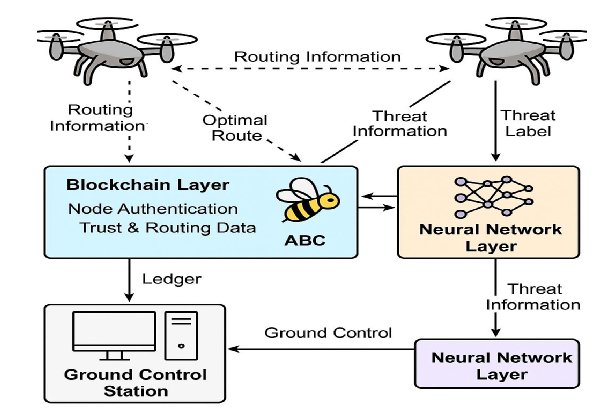
Flying Ad Hoc Networks (FANETs), composed of decentralized Unmanned Aerial Vehicles (UAVs), are increasingly deployed in military, disaster relief, and smart surveillance applications. However, their open wireless architecture and high mobility make them susceptible to routing-based attacks such as black hole, Sybil, and denial-of-service (DoS), compromising communication integrity and network reliability. This study aims to design a secure, intelligent, and resource-efficient routing framework for FANETs that integrates decentralized trust management and real-time threat detection. The proposed system combines three core components: a lightweight blockchain layer to establish tamper-proof trust scores, an Artificial Bee Colony (ABC) algorithm adapted with security-aware fitness functions for optimized route selection, and a Convolutional Neural Network (CNN) model for real-time classification of node behavior. Simulations were conducted in NS-3 with a UAV swarm of 30 nodes using realistic 3D mobility patterns and injected attack scenarios. The CNN classifier was trained using traffic features such as delay, retransmission rate, and energy drop, achieving an overall detection accuracy of 94.1%. The integrated system improved the Packet Delivery Ratio (PDR) to 91.8%, reduced routing overhead by 35%, and maintained end-to-end delay under 100 ms, outperforming AODV, SAODV, and ABC-only baselines with statistical significance (p < 0.01). The results demonstrate that the combined use of blockchain, bio-inspired optimization, and neural intrusion detection offers a robust and scalable solution for real-time, secure communication in hostile or mission-critical FANET environments.
Downloads
Published
Issue
Section
License

This work is licensed under a Creative Commons Attribution-NonCommercial 4.0 International License.
This work is licensed under a Creative Commons Attribution-NonCommercial 4.0 International License. You are free to share and adapt the material, but only for non-commercial purposes. You must give appropriate credit to the author(s).