Classification Models and Diagnostic Prediction for Detection of Kidney Disease Using Machine Learning Methods
Keywords:
Logistic Regression, XGBoost, Random Forest, ANN, SMOTE, PCA, Logarithmic Ensembling.Abstract
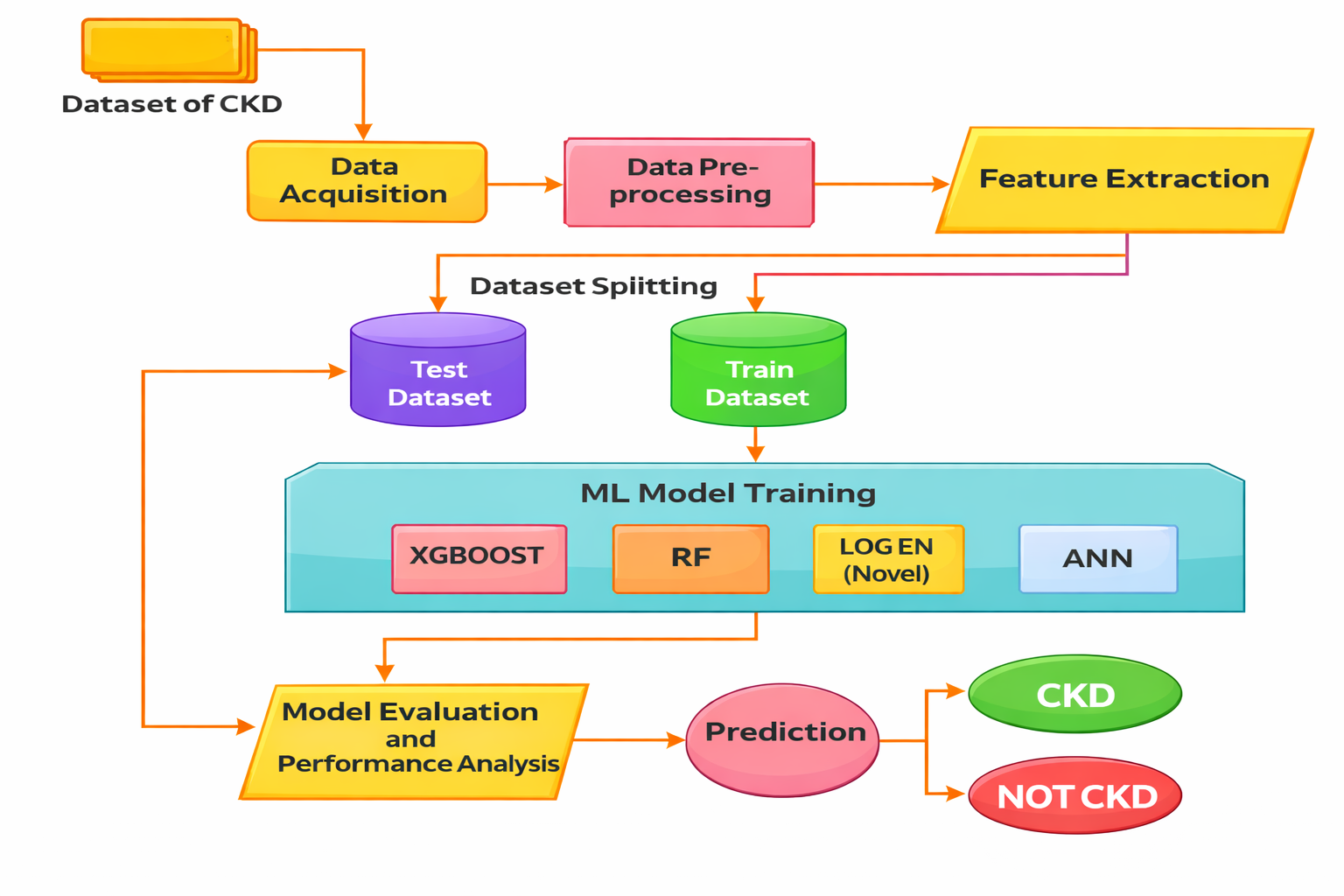
Chronic Kidney Disease (CKD) is a progressive and potentially fatal condition that often goes undetected in its early stages, resulting in delayed treatment and increased healthcare costs. Conventional diagnostic approaches rely heavily on laboratory tests and expert interpretation, which may be time-consuming, costly, and prone to inaccuracies due to missing or imbalanced clinical data. To address these limitations, this study proposes a robust and interpretable machine learning–based framework for the early prediction of CKD. The proposed system is evaluated using a publicly available CKD dataset containing clinical and laboratory attributes such as serum creatinine, blood urea, blood pressure, albumin, hemoglobin, and diabetes status. To enhance data quality, missing values are handled using median and most-frequent imputation, while normalization and categorical encoding ensure consistency across features. Class imbalance is mitigated using the Synthetic Minority Over-sampling Technique (SMOTE). Feature dimensionality is reduced using Principal Component Analysis (PCA), and SHAP (Shapley Additive Explanations) is employed to identify the most influential biomarkers and improve model interpretability. Multiple machine learning models, including Logistic Regression, Random Forest, XGBoost, and Artificial Neural Networks (ANN), are trained and evaluated. A novel Logarithmic Ensemble model is introduced to combine the strengths of individual classifiers. Experimental results demonstrate that the proposed ensemble model achieves superior performance, with an accuracy of 97.45%, precision of 99.57%, recall of 95.30%, F1-score of 97.39%, and an AUC-ROC score of 0.9986, outperforming all baseline models. The findings indicate that ensemble learning combined with effective preprocessing and explainability techniques significantly enhances CKD prediction. This approach offers a reliable, interpretable, and scalable solution for early diagnosis, supporting timely clinical intervention and improved patient outcomes.
Downloads
Published
Issue
Section
License
Copyright (c) 2023 M. Susmitha, B.Venkata Seshu Kumari (Author)

This work is licensed under a Creative Commons Attribution-NonCommercial 4.0 International License.
This work is licensed under a Creative Commons Attribution-NonCommercial 4.0 International License. You are free to share and adapt the material, but only for non-commercial purposes. You must give appropriate credit to the author(s).