Design and Development of Bio-orthogonal Feedback Loops for Synthetic Cell Memory Systems
Keywords:
Bio-orthogonal Feedback Loops, Genetic Toggle Switches, Multi-bit Memory, Noise Robustness, Synthetic Biology, Synthetic Cellular MemoryAbstract
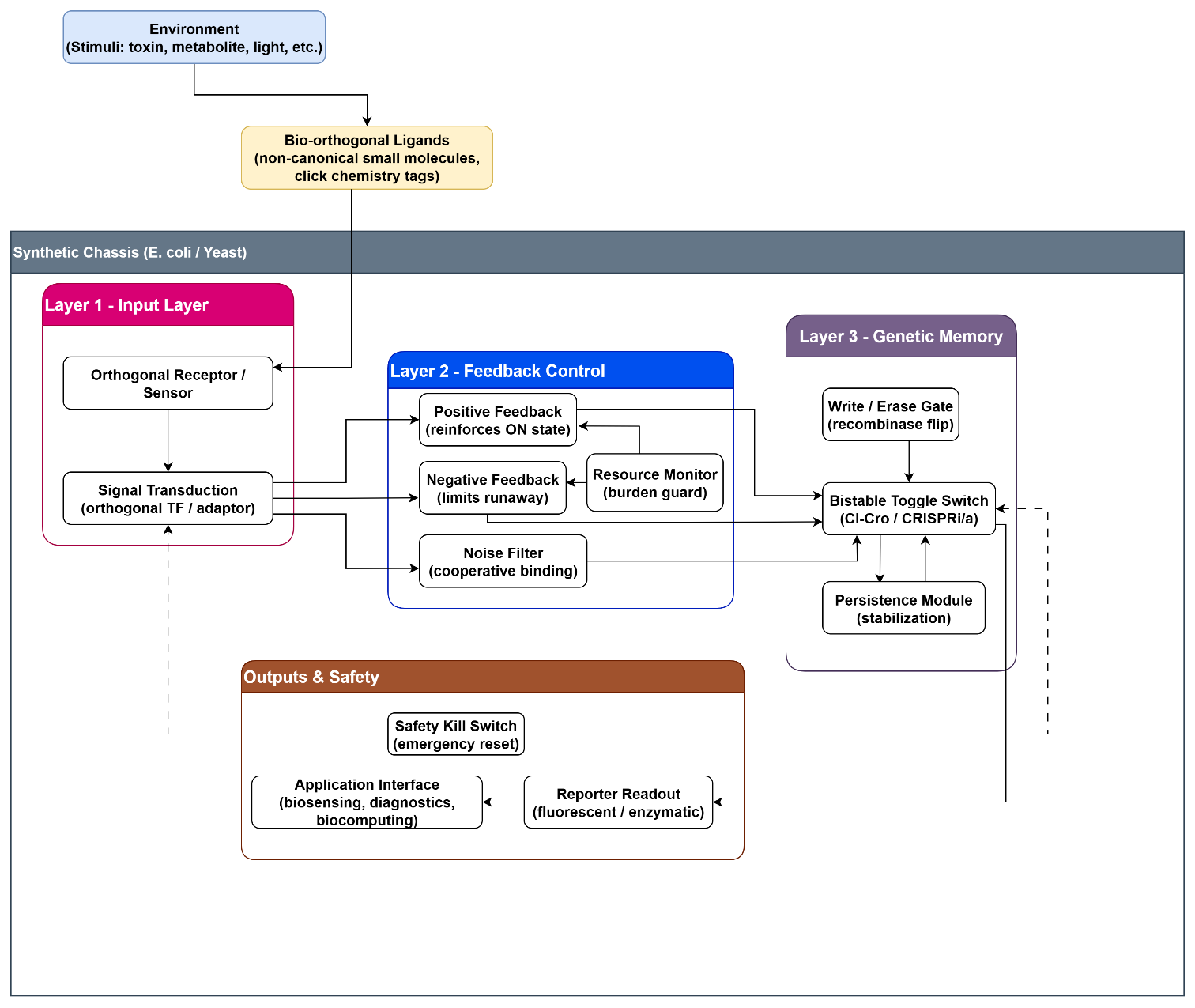
Synthetic memory systems allow engineered cells to store information across generations and find applications in biosensing, diagnostics, and biocomputational. However, existing designs (such as toggle switches and CRISPR-based recorders) have limitations, including short retention times, irreversibility, and biosafety issues requiring genome-wide modifications. These limitations hinder the development of reliable and scalable systems. This study addresses these challenges by proposing a bio-orthogonal feedback loop-based synthetic memory model that combines orthogonal ligand-receptor signalling with dual feedback regulation. The goal is to achieve long-term stability, fault-tolerant switching, noise damping, reduced metabolism, and the maintenance of system reversibility and scalability. The research design integrates theoretical and experimental approaches. A detailed mathematical representation (Eqns. 1-13) was developed to explain the activation of the ligand, feedback, biostability, toggle behaviour, recombinase-mediated switching, and metabolic load. Simulations were conducted using both deterministic and stochastic methods, and empirical validation was performed with microbial chassis using fluorescence assays, flow cytometry, lineage tracking, and growth rate analysis. The findings demonstrated retention of 38-40 generations, a switching probability exceeding 90%, noise resistance (NR = 0.84), and a reduced metabolic load of 14.6%. Additionally, the framework achieved multi-bit fidelity of 91% in four states, which is favourable compared to classical memory systems. In conclusion, the proposed framework offers a scalable, reversible, and biosafe synthetic cell memory architecture for developing programmable bio computation and biosensing applications in synthetic biology.
Downloads
Published
Issue
Section
License

This work is licensed under a Creative Commons Attribution-NonCommercial 4.0 International License.
This work is licensed under a Creative Commons Attribution-NonCommercial 4.0 International License. You are free to share and adapt the material, but only for non-commercial purposes. You must give appropriate credit to the author(s).