A Quantum-Inspired Framework for Assessing Volatility, Divergence, and Collapse in Public Opinion
Keywords:
Collapse Events, Measurement Disturbance, Opinion Dynamics, Poll Stability, Quantum Social Science, Social Media VolatilityAbstract
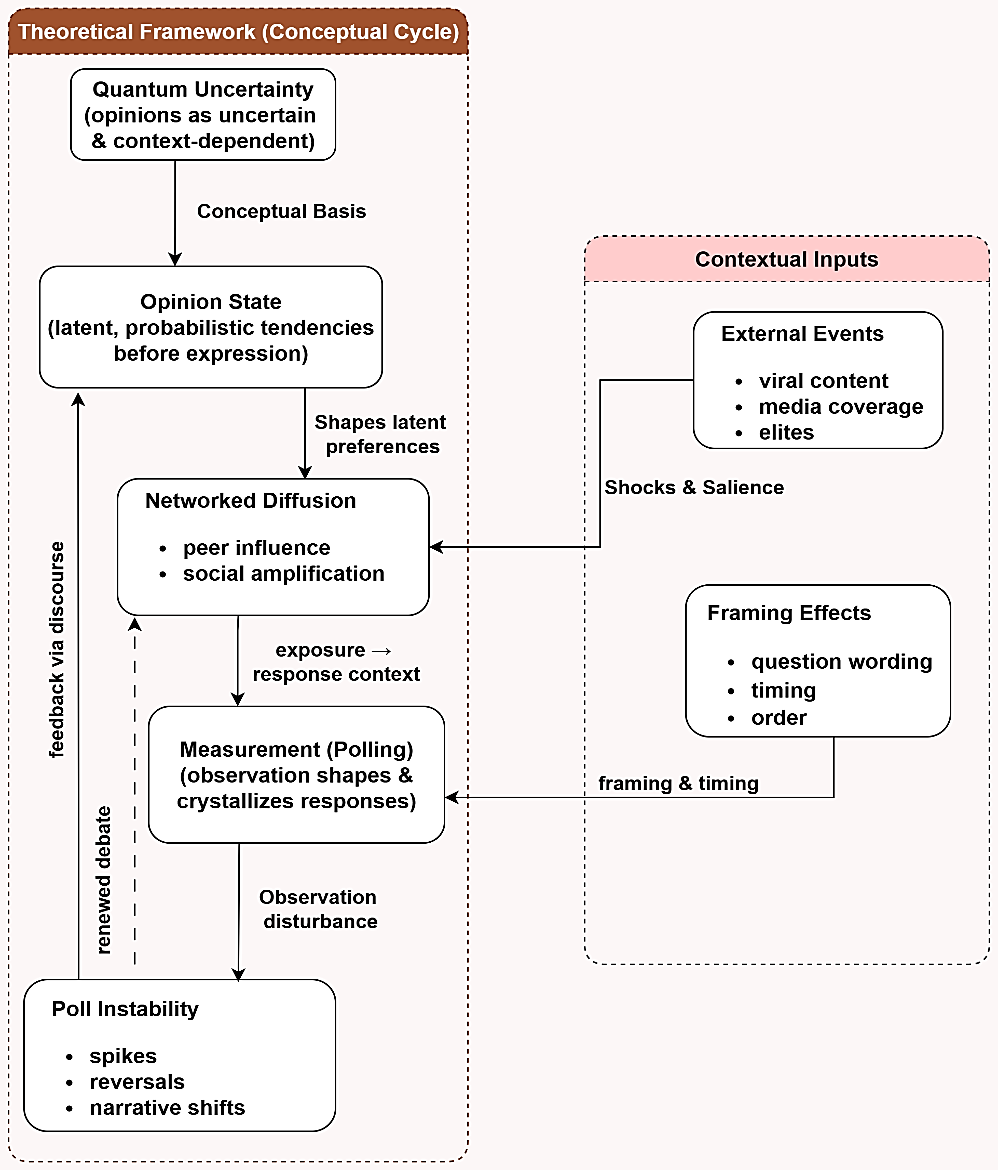
The use of opinion polling to gauge societal preferences is not new, but social media has disrupted assumptions of stability and representativeness. Viral moments, fake news, and rapid shifts in sentiment due to quick online communication are volatile, divergent, and unpredictable, which traditional polling methods do not capture. Classical survey methods assume consistent opinions over time, leading to discrepancies between poll forecasts and real-time discussions. Additionally, the polling process itself can influence respondents' behavior. These challenges necessitate new models that account for instability, uncertainty, and context dependence. This paper presents a quantum-inspired model that views public opinion as probabilistic states that can collapse upon measurement, reflecting the inherent instability of digital political discourse. The study evaluates variables using Indian Politics Tweets and Reactions data, employing opinion dynamics based on three metrics: the Opinion Volatility Index (OVI), the Poll Divergence Metric (PDM), and the Stability Collapse Indicator (SCI). It integrates data preprocessing, network-based opinion diffusion modeling, and measurement disturbance to assess volatility and divergence. Results indicate that volatility is inherent to online discourse: OVI shows peaks during viral events, PDM reveals widening gaps between polls and social media signals, and SCI captures events where small shocks lead to significant opinion shifts. These findings suggest that the stability of polls is weakening in networked environments. The quantum-inspired approach provides a theoretical and methodological framework for rethinking opinion measurement, opening new avenues in computational political science.
Downloads
Published
Issue
Section
License

This work is licensed under a Creative Commons Attribution-NonCommercial 4.0 International License.
This work is licensed under a Creative Commons Attribution-NonCommercial 4.0 International License. You are free to share and adapt the material, but only for non-commercial purposes. You must give appropriate credit to the author(s).