Personalized Cancer Treatment Recommendation Using Federated Graph Neural Networks Across Healthcare Institutions
Keywords:
Federated Learning, Graph Neural Networks, Personalized Medicine, Cancer Treatment Recommendation, Privacy-Preserving AI, Clinical Decision Support, BRCA Multi-Omics, AUC-ROC, Federated Aggregation, Multi-Institution Collaboration.Abstract
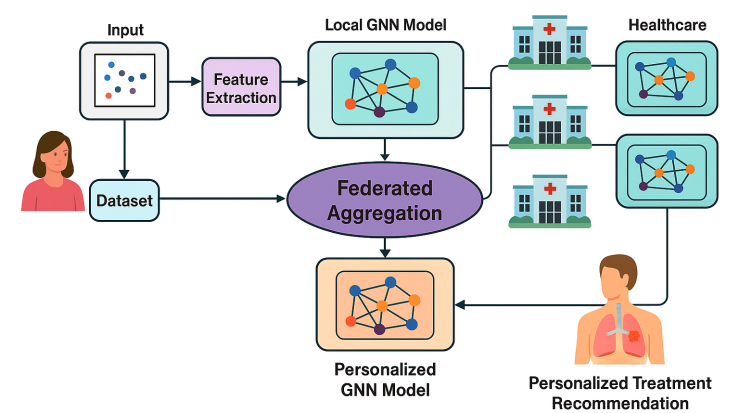
Personalized cancer treatment requires access to diverse and large-scale patient data to train accurate predictive models. However, privacy regulations and data silos across healthcare institutions significantly hinder the development of collaborative, generalizable AI-driven clinical decision support systems. This study aims to develop a federated graph neural network (Fed-GNN) framework that enables privacy-preserving, multi-institutional collaboration for personalized cancer treatment recommendation. The proposed framework models patients as graph nodes and constructs inter-patient similarity graphs using genomic, clinical, and therapeutic data from the BRCA Multi-Omics TCGA dataset. Each institution trains a local GNN on its private patient graph and shares only encrypted model parameters with a central server, where global aggregation is performed using the FedAvg algorithm. A local personalization layer further fine-tunes the global model to reflect institution-specific patient characteristics. Experiments conducted on a horizontally partitioned dataset across four simulated institutions show that the proposed Fed-GNN achieves an accuracy of 92.3%, precision of 0.91, recall of 0.93, and AUC-ROC of 0.94, outperforming centralized GNN, federated MLP, and standalone models. The framework demonstrates resilience under non-IID settings and client dropout scenarios, maintaining >87% accuracy even with 20% client unavailability. The Fed-GNN framework effectively enables collaborative, secure, and high-performing cancer treatment recommendation across distributed healthcare networks. This approach paves the way for real-world deployment of federated AI in clinical oncology, balancing predictive accuracy with patient data confidentiality
Downloads
Published
Issue
Section
License

This work is licensed under a Creative Commons Attribution-NonCommercial 4.0 International License.
This work is licensed under a Creative Commons Attribution-NonCommercial 4.0 International License. You are free to share and adapt the material, but only for non-commercial purposes. You must give appropriate credit to the author(s).