Emotion-Responsive Virtual Agents Using Generative Memory-Augmented Cognitive Architectures
Keywords:
Emotion-aware virtual agents, generative dialogue models, memory-augmented neural networks, cognitive architectures, empathetic AI, affective computing, human-computer interactionAbstract
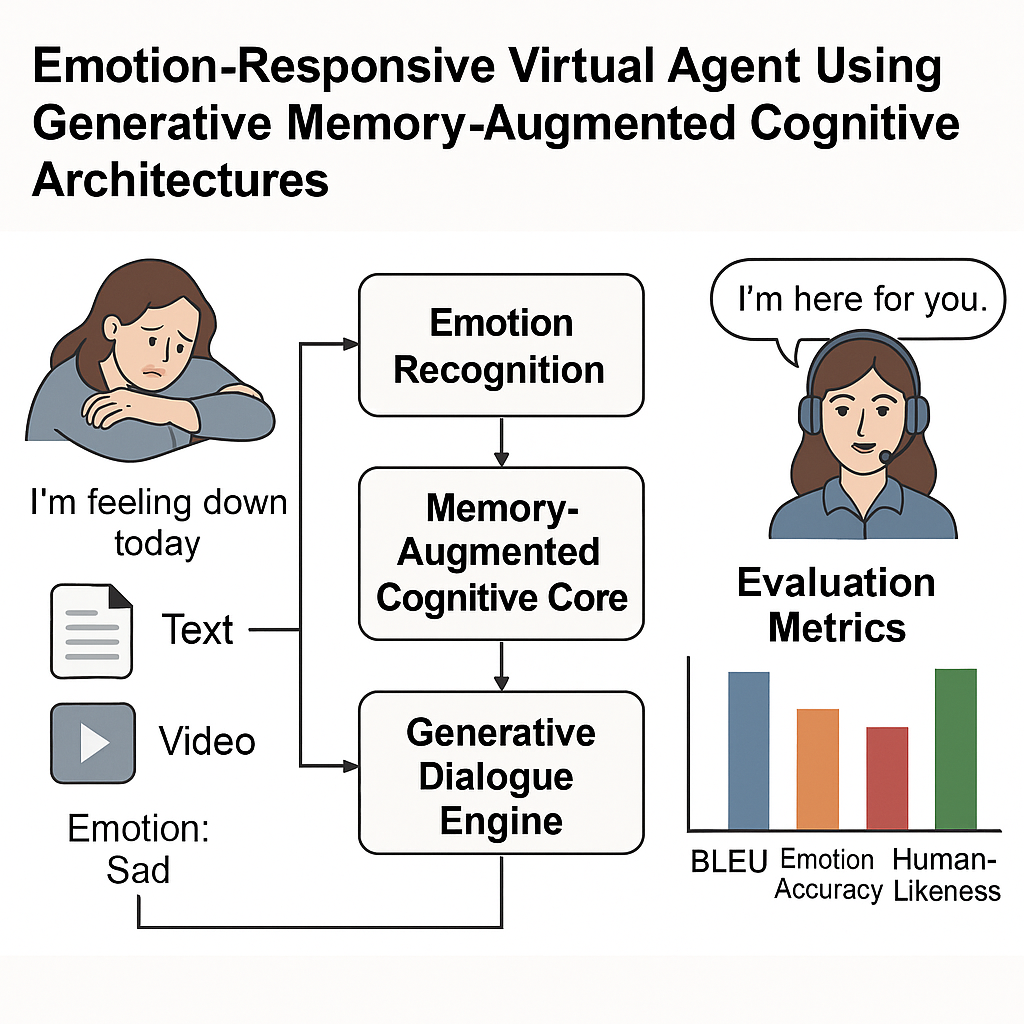
Virtual agents are increasingly deployed in emotionally sensitive domains such as mental health, education, and social robotics. However, existing systems often lack emotional coherence, contextual awareness, and memory retention, limiting their ability to deliver human-like interactions. This study aims to develop an emotion-responsive virtual agent using a Generative Memory-Augmented Cognitive Architecture (GMCA) that integrates emotion recognition, episodic memory, and context-aware response generation. The proposed GMCA framework incorporates a multimodal emotion recognition module, a differentiable external memory for storing emotion-tagged dialogue history, and a generative response engine conditioned on both emotion and memory contexts. The system is trained and evaluated on benchmark datasets including IEMOCAP, DailyDialog, and custom user-agent interaction logs. Key metrics include BLEU score, Emotion Accuracy (EA), Memory Utility (MU), and Human-Likeness Score (HLS). Experimental results show that GMCA outperforms existing empathetic and transformer-based dialogue systems. Specifically, it achieves a BLEU score of 16.9, an EA of 74.5%, a Memory Utility score of 0.78, and an HLS of 4.3 out of 5. These represent improvements of +3.8 BLEU, +12.6% EA, and +0.6 HLS over the strongest baseline. By unifying affective computing, memory augmentation, and generative cognitive modeling, GMCA enables emotionally intelligent, context-aware interactions. The model demonstrates strong applicability in real-world scenarios requiring empathetic engagement, setting a new benchmark for emotion-aware conversational AI
Downloads
Published
Issue
Section
License

This work is licensed under a Creative Commons Attribution-NonCommercial 4.0 International License.
This work is licensed under a Creative Commons Attribution-NonCommercial 4.0 International License. You are free to share and adapt the material, but only for non-commercial purposes. You must give appropriate credit to the author(s).