Adaptive Curriculum Generation Using Reinforcement Learning from Student Interaction and Knowledge Graphs
Keywords:
Adaptive Learning, Curriculum Generation, Reinforcement Learning, Knowledge Graphs, Student Modeling, Personalized Education, Intelligent Tutoring SystemsAbstract
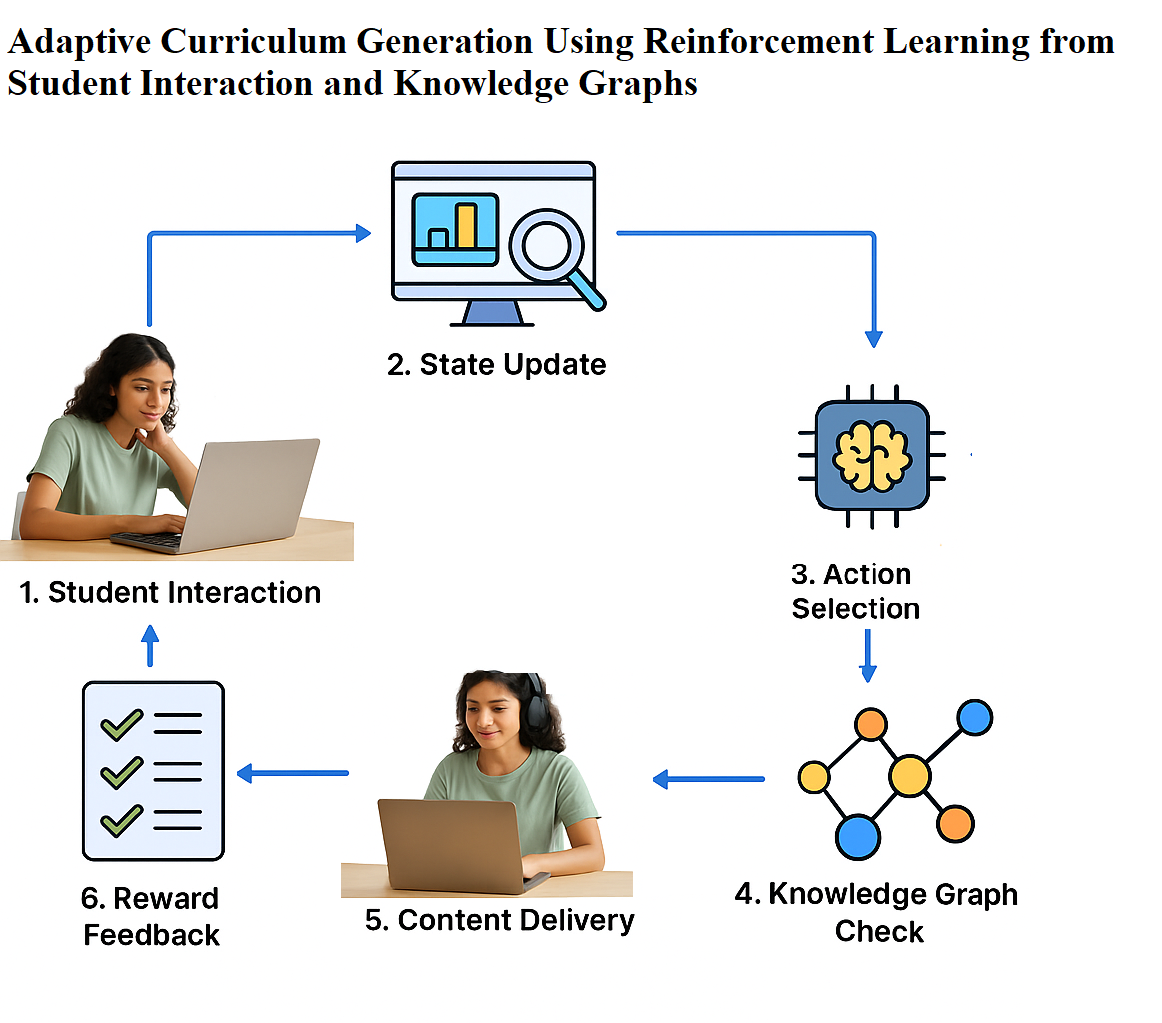
Personalized curriculum design remains a significant challenge in intelligent tutoring systems due to the complexity of adapting content to individual learner needs while maintaining pedagogical integrity. Traditional adaptive systems often lack scalability or fail to consider prerequisite relationships among concepts, resulting in inefficient learning trajectories. This study proposes a reinforcement learning-based framework integrated with knowledge graphs to generate adaptive, data-driven learning paths tailored to student interaction patterns. The goal is to develop a scalable and intelligent curriculum generation model that dynamically adapts to learners while ensuring domain coherence. The proposed system models the curriculum generation task as a Markov Decision Process (MDP), where student knowledge states are inferred from performance and engagement data. A Q-learning agent selects the next concept, constrained by prerequisite rules encoded in a domain-specific knowledge graph. The ASSISTments 2017 dataset was used for experimentation, and the model’s effectiveness was benchmarked against three baseline systems: Static Sequence Model (SSM), Random Concept Selector (RCS), and Bayesian Knowledge Tracing (BKT). Experimental results show that the proposed model achieved a Normalized Learning Gain (NLG) of 0.61, outperforming BKT (0.48), SSM (0.41), and RCS (0.36). It also achieved a Curriculum Efficiency (CE) of 0.79 and a Cumulative Reward (CR) of 21.3, significantly higher than all baselines. Statistical significance was confirmed with p-values < 0.01 across key metrics. This research contributes a robust, interpretable solution for adaptive curriculum generation. It offers practical value for e-learning platforms by enabling real-time personalization that respects instructional dependencies, improving both engagement and learning outcomes at scale
Downloads
Published
Issue
Section
License

This work is licensed under a Creative Commons Attribution-NonCommercial 4.0 International License.
This work is licensed under a Creative Commons Attribution-NonCommercial 4.0 International License. You are free to share and adapt the material, but only for non-commercial purposes. You must give appropriate credit to the author(s).