Hybrid Ensemble Learning for Real-Time Predictive Maintenance in Vehicular Engine Health Monitoring Systems
DOI:
https://doi.org/10.70162/fcr/2025/v3/i2/v3i201Keywords:
Predictive Maintenance, Ensemble Learning, Engine Diagnostics, Deep Learning, Vehicle Health Monitoring, Intelligent Transportation SystemsAbstract
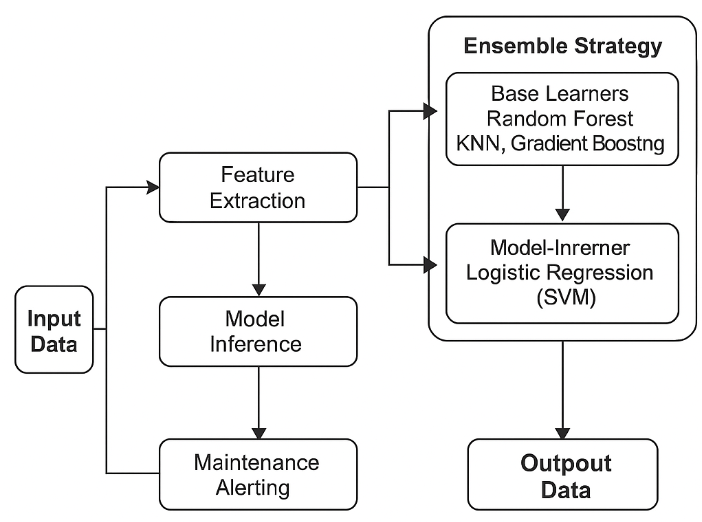
Vehicular engine failures are a major contributor to unplanned maintenance costs, operational downtime, and reduced road safety. Traditional diagnostic systems often rely on rule-based thresholds or simple machine learning models, which struggle to detect complex, evolving engine faults under real-world conditions. Accurate and interpretable predictive maintenance frameworks are essential to address the increasing demand for intelligent and reliable engine health monitoring. This study proposes a novel hybrid ensemble learning framework for real-time engine fault detection and classification, aimed at enhancing prediction accuracy and diagnostic robustness. The system integrates multiple base classifiers—Random Forest (RF), K-Nearest Neighbors (KNN), and Gradient Boosting (GBM)—within a stacked generalization architecture, using a Logistic Regression meta-learner. Deep learning enhancements, including an attention-augmented LSTM module, are applied to capture temporal patterns in engine sensor data. Real-time data from OBD-II and CAN bus systems are preprocessed using normalization, label encoding, and outlier handling techniques. Experimental evaluations on a multi-parameter engine dataset demonstrate that the proposed ensemble model achieves an accuracy of 90.2%, outperforming baseline models such as RF (86.5%) and SVM (85.4%). The system also reduces the false positive rate to 4.2%, and improves recall for rare but critical faults. This work contributes a scalable, interpretable, and high-performance diagnostic solution with strong applicability to Edge AI, fleet maintenance systems, and connected vehicle ecosystems.
Published
Data Availability Statement
Data available upon request.Issue
Section
License

This work is licensed under a Creative Commons Attribution 4.0 International License.
Public Licensing Terms
This work is licensed under a Creative Commons Attribution 4.0 International License (CC BY 4.0).
You are free to:
- Share: Copy and redistribute the material in any medium or format.
- Adapt: Remix, transform, and build upon the material for any purpose, even commercially.
Under the following terms:
- Attribution: You must give appropriate credit, provide a link to the license, and indicate if changes were made. You may do so in any reasonable manner, but not in any way that suggests the licensor endorses you or your use.
To view a copy of this license, visit http://creativecommons.org/licenses/by/4.0/.